Existing humanoid locomotion systems primarily focus on stability and task execution, while integrating expressiveness with explicit locomotion control remains challenging. We propose EMoG, an emotion-modulated gait generation framework for expressive humanoid locomotion. EMoG introduces an emotional-style code with continuously adjustable intensity. Conditioned on this code and physical commands, a lightweight MLP generates expressive, command-consistent periodic gait trajectories in real time, which are tracked by a unified reinforcement learning policy for physical execution. To support training, we collect a large-scale emotion-annotated gait dataset from professional performers and develop an automated pipeline to extract physically consistent periodic gait cycles. EMoG also integrates an LLM-based parser that converts free-form language into emotional style and motion parameters for interactive control. Experiments demonstrate that our system achieves continuous gait-style modulation with perceptible expressive cues while maintaining command tracking. EMoG provides a practical approach to parameterized emotional-style walking for human-robot interaction.
Results
Walking with Different Emotions
😊 Happy
😢 Sad
😎 Confident
😨 Scared
Results
Gait Changes as Emotional Intensity Increases from Low to High
😊 Happy
😢 Sad
😨 Scared
Results
Emotion-Aware Gait Generation from Textual Input
Language-driven emotional-style gait
Method
Method
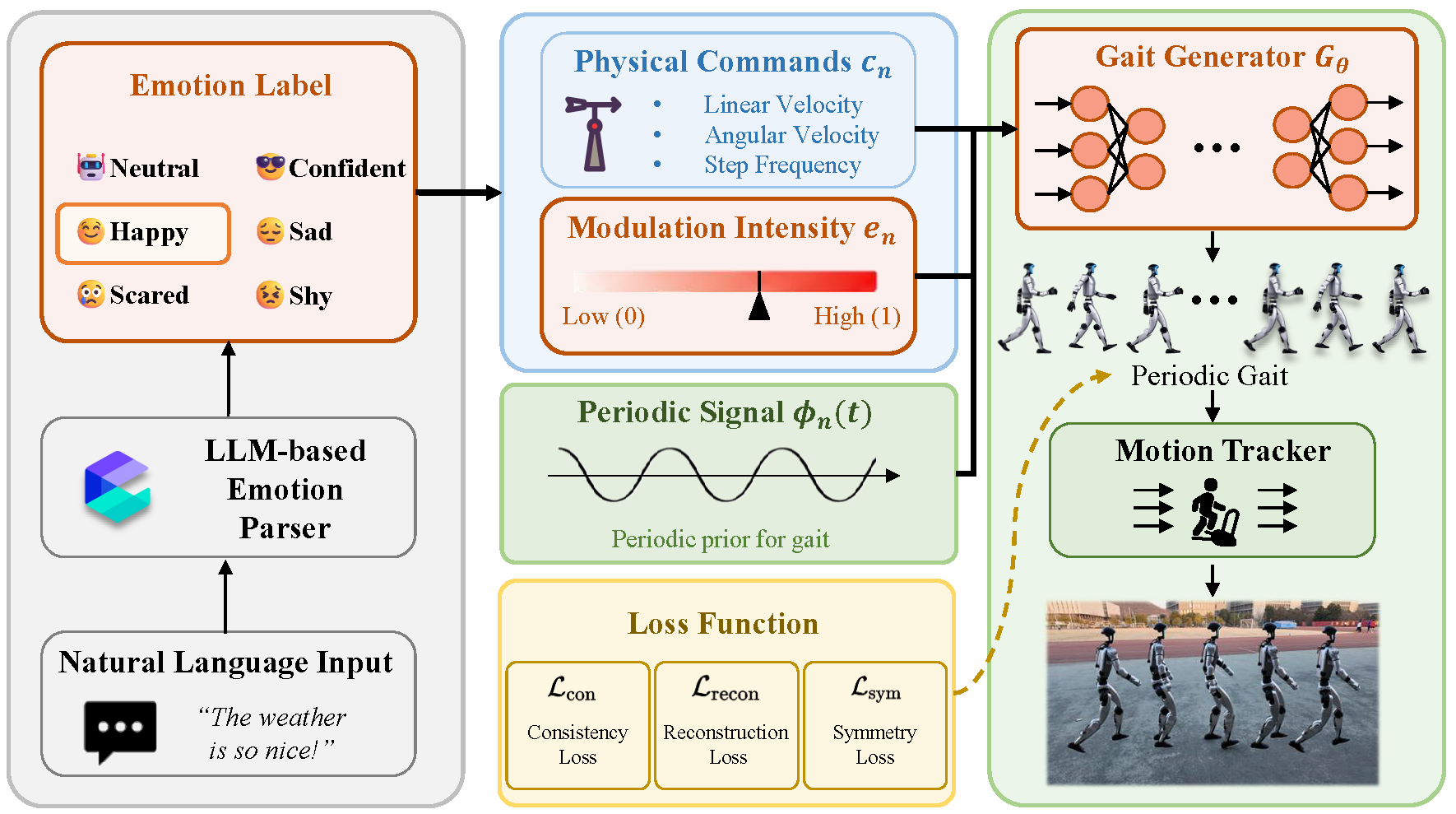
Figure 1. EMoG centers on an emotional-style gait generator that takes a continuously emotional-style modulation code and separately specified physical commands as inputs, generating real-time whole-body periodic reference trajectories, which are executed on a humanoid by a downstream unified motion tracker. The framework also connects to an LLM-compatible language interface that parses emotional cues and motion instructions from text into style parameters and physical commands, enabling intuitive interaction while maintaining explicit control over gait style and physical commands.
Figure 2. Pipeline for emotion-annotated gait collection and refinement